Media discourse shapes our understanding by conveying explicit and implicit meanings that influence public opinion.
Üyeler sınırsız test çözer, dersi dinler, Bir'e Bir ders alır ve ilerlemesini görür. Üye olmadan 20 dakika deneyebilirsin.
Introduction to Media Discourse and Implicit Meaning

Media discourse refers to the way media communicates messages through language, images, and sounds. It conveys not only explicit information but also implicit meanings that influence how audiences interpret the message.
Implicit meaning is the hidden or suggested meaning behind the words or images used in media. It often relies on cultural codes, stereotypes, or emotional appeals to shape the audience's understanding without stating it directly.
Örnek
For example, a news headline saying “City in chaos after protest” might implicitly suggest that the protesters are violent, even if the article describes peaceful demonstrations.
Analyzing Media Discourse: Key Techniques

To analyze media discourse, we look at language choices, framing, and visual elements. Words with positive or negative connotations can guide the audience's feelings about a topic.
Framing refers to how a story is presented, highlighting certain aspects while ignoring others. Visuals like photos or videos often reinforce the implicit message by evoking emotions or stereotypes.
Örnek
Consider a political article describing a candidate as “strong and decisive” versus “stubborn and aggressive.” The explicit information might be similar, but the implicit meaning differs, influencing readers’ opinions.
Classroom Discussion on Media Discourse and Implicit Meaning
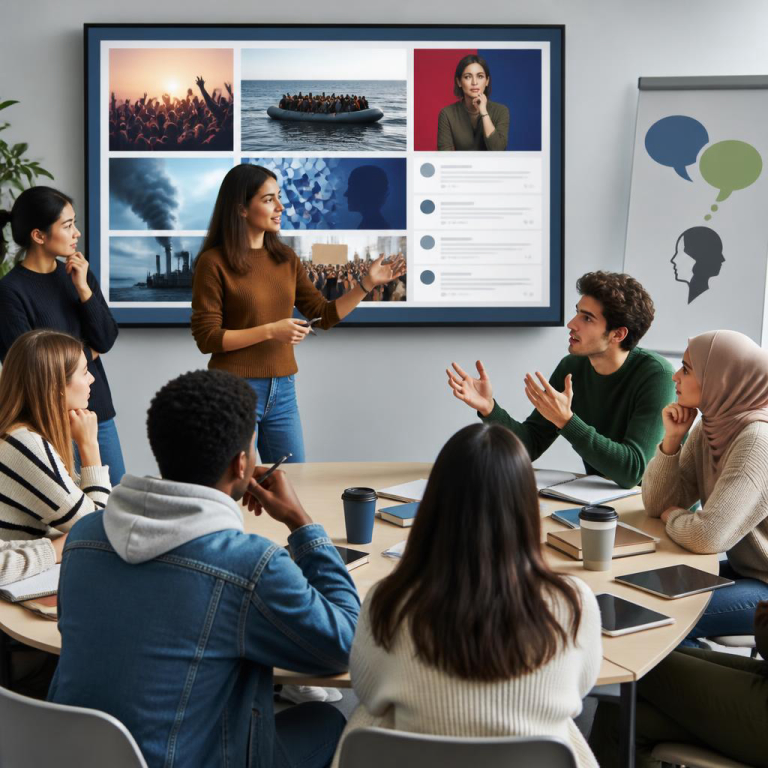
In classroom discussions, students share diverse interpretations of media texts based on their backgrounds and experiences. This exchange helps uncover multiple layers of meaning and challenges personal biases.
Such discussions encourage critical thinking by questioning the source, purpose, and impact of media messages, helping students become more discerning consumers of information.
Örnek
For instance, some students might see a news report as objective, while others detect bias or hidden agendas, leading to a richer understanding of media influence.
Interactive Workshop: Creating and Analyzing Media Texts

In workshops, students create their own media texts, such as articles or videos, to practice embedding and identifying implicit meanings. This hands-on experience reveals how language and visuals can shape messages subtly.
By analyzing peer-created content, students learn to spot techniques like framing, selective detail, and emotional appeals, strengthening their analytical skills.
Örnek
One group might produce a news story about a local event using positive language and uplifting images, while another group uses neutral or negative tones, demonstrating how meaning changes with presentation.
Presenting Media Discourse Analysis: Writing a Column

Writing a column requires organizing ideas clearly and supporting opinions with evidence from media texts. Students learn to explain both explicit content and implicit meanings to their readers.
Effective columns use persuasive language, examples, and sometimes rhetorical questions to engage the audience and encourage critical reflection on media influence.
Örnek
A student might write a column analyzing a popular advertisement, explaining how it uses stereotypes to sell a product and why that matters for society.
Sık yapılan yanlışlar
- Yanlış: Implicit meaning is always negative or manipulative. Doğrusu: Implicit meaning can be neutral or positive; it simply refers to meanings suggested rather than directly stated.
- Yanlış: Media discourse only involves written texts like newspapers. Doğrusu: Media discourse includes all forms of media communication, such as TV, radio, social media, and images.
- Yanlış: Identifying implicit meaning is purely subjective and unreliable. Doğrusu: While interpretation involves subjectivity, critical analysis uses evidence and context to support conclusions about implicit meanings.
- Yanlış: All media messages are biased and cannot be trusted. Doğrusu: Not all media is biased; some aim for objectivity, but critical thinking helps distinguish reliable from unreliable sources.
- Yanlış: Implicit meanings are easy to spot without training. Doğrusu: Recognizing implicit meanings requires practice and understanding of language, culture, and media techniques.
Bir adım ileri
At a higher level, students explore discourse analysis in different media genres and cultural contexts, studying how power relations and ideology shape media messages. They learn advanced methods like critical discourse analysis and semiotics to uncover deeper social implications and develop sophisticated media literacy skills.
Özet
Media discourse conveys both explicit and implicit meanings that influence how we understand the world. Analyzing language, framing, and visuals helps reveal hidden messages. Developing these skills enables critical consumption and production of media content, fostering informed and reflective individuals.